


What is a Trunked Radio System & How Does It Work?
A facility's two-way radio system begins to show its limits before most managers notice. Channels fill up during shift changes. Departments step on each other's transmissions. A maintenance crew trying to report a spill waits 45 seconds for a clear channel, and that's on a normal day.
A trunked radio system solves this, but not by adding more channels. It solves it by making the channels you already have work harder. That distinction matters more than it sounds. Many operations add more conventional channels before finding out that channel count isn't the real problem. Traffic management is.
How Conventional Radio Systems Run Out of Room
In a conventional system, each department owns its channel. Security talks on Channel 1. Maintenance on Channel 2. Operations on Channel 3. When nobody's using Channel 2, it sits empty. When everyone on Channel 3 needs to talk at once, they queue up and wait.
This is horizontal loading — channels are assigned one at a time until none remain. ISED's RP-003 policy on mobile radio trunked systems directly describes the problem: in a conventional setup, spectrum sits unused on quiet channels while busy ones block users who need access. The inefficiency is built into the architecture.
For small teams with low traffic and predictable patterns, conventional works well enough. But once you're running five or more departments across a large facility, or managing shift overlap where everyone needs the radio at once, conventional systems hit a ceiling that more channels alone won't fix.
What Trunking Does to a Radio Channel
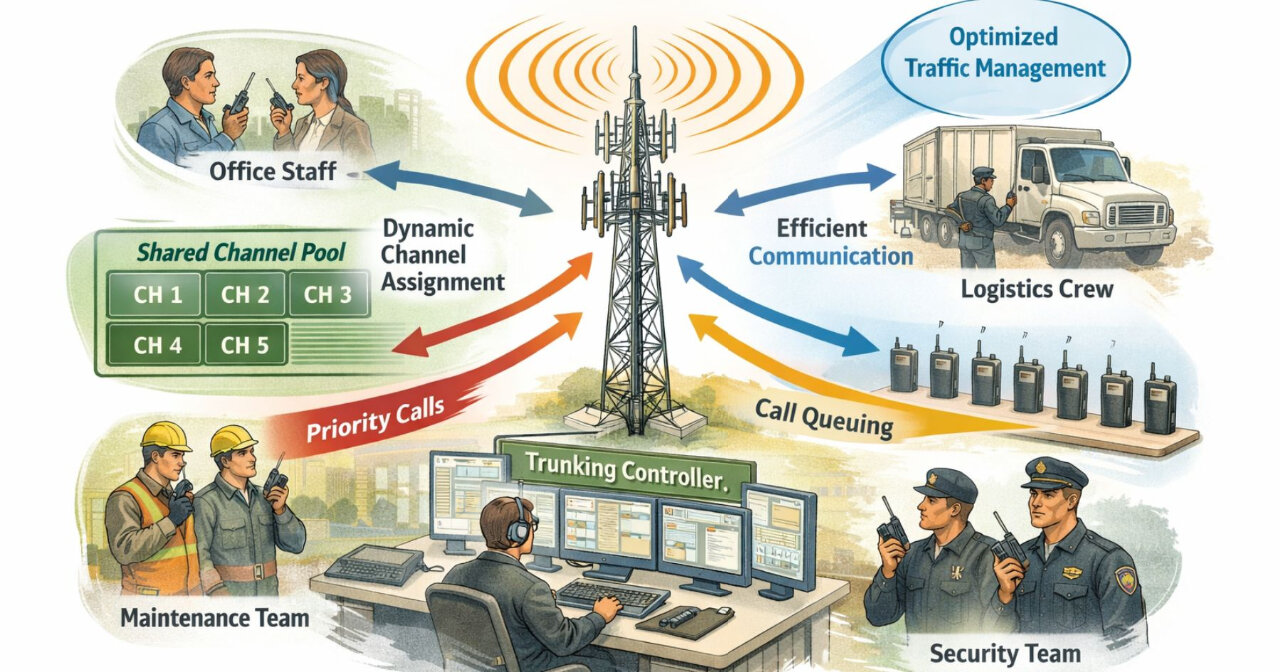
A trunked system pools all available channels into a shared group. No department owns a channel permanently. When a user presses push-to-talk, the system assigns whichever channel is free, routes the call through, and releases the channel when the transmission ends. The whole exchange happens in under a second.
The DMR Association's standards documentation defines this under DMR Tier III, the trunking tier of the Digital Mobile Radio standard developed by ETSI. Tier II covers standard digital operation. Tier III adds the trunking layer: dynamic channel assignment, the control channel, and the infrastructure that coordinates traffic across the pool.
The efficiency gain is real and measurable. A five-channel conventional system gives you five simultaneous conversations, full stop. A five-channel trunked system supports significantly more active users because most transmissions are short and channels return to the pool almost immediately after each one ends. The pool grows more useful the more users share it.
How the Control Channel Manages Traffic in Real Time
Every trunked system runs a dedicated control channel. This channel carries no voice, only data: check-in signals from radios joining the system, channel assignment commands, and system status updates. It's the coordination layer that enables dynamic allocation.
When a user keys up, their radio sends a request to the system controller over the control channel. The controller checks which voice channels are free, assigns one, and sends that assignment back — all in the same fraction of a second. The radio locks onto the assigned channel, the call goes through, and the channel releases when the transmission ends.
In a conventional system, a user manually selects a channel and hopes it's clear. In a trunked system, the controller handles that entirely. Users never scan for open channels, never step on transmissions, and never manually switch departments during an incident.
The control channel also handles registration, so the system always knows which radios are active. This enables features conventional systems can't support: emergency alerts that identify which radio triggered them, GPS data tied to specific users, and man-down detection that sends an automatic distress signal if a radio stops moving.
Talkgroups: How Departments Share the Same Infrastructure
Talkgroups replace fixed channel assignments with configurable virtual groups. Maintenance has one. Security has one. Operations has one. During an incident, a supervisor can patch talkgroups together so all three communicate on the same call — without anyone changing a physical channel.
This is useful for facilities that run multiple operational modes. Day shift and night shift may have different talkgroup structures. A plant-wide emergency may require a broadcast talkgroup that every radio on-site can hear. A contractor crew working a specific zone can be added to a temporary talkgroup and removed when the work ends — no reprogramming required.
Talkgroups also keep departments separated in ways conventional channels can't. In a trunked system, talkgroups are logically separated at the system level, so maintenance doesn't hear security unless the system is configured to bridge them.
Where Trunked Systems Fail Without Proper RF Planning
Trunking is a channel management solution, not a coverage solution. A trunked system installed without an RF coverage study will have the same dead zones as a conventional one, and they'll be harder to diagnose. The control channel is the most critical single point in the system.
If a radio loses contact with it — behind a concrete wall, in a basement stairwell, inside a metal-clad storage room — it falls out of the trunked network entirely. It won't receive channel assignments until it re-registers. In a conventional system, a user in a weak-signal area might still catch intermittent transmissions. In a trunked system, control channel loss is a hard cutoff. That's a meaningful difference during an incident when re-registration takes several seconds, and the transmission window has already closed.
This is why a distributed antenna system (DAS) is often used alongside trunked deployments in multi-floor facilities. The DAS ensures control channel coverage reaches areas where the main RF signal can't penetrate. Miss the antenna polarisation match, and you'll lose 3–6 dB before the signal even leaves the building — and that loss doesn't show up on a drawing.
ISED Licensing and the Ontario Context
Trunked systems in Canada require coordinated frequency licensing through ISED. RP-003 states that in major urban areas — including the census metropolitan areas covering Kitchener, Hamilton, London, and Toronto — any new mobile system requiring more than three channels must use trunking as a condition of licence.
The application process is more involved than a conventional licence. ISED requires a system description, a five-year channel growth plan, a justification for the requested number of frequencies, and expected service quality parameters.
A trunked system in the 400 MHz or 800 MHz band is typically authorized for at least four frequencies. The system must also meet at least 70% of the minimum loading criteria during the licence term.
This is the standard process. But frequency selection and early system design decisions have licensing consequences that can take time to unwind if they need to change. Getting the technical documentation right before submission saves months.
When a Trunked Deployment Makes Sense for Your Facility
Trunking makes sense when a facility is hitting channel capacity — channels jammed during peak hours, departments blocking each other, users waiting to transmit when it counts. It also makes sense when safety requirements demand features conventional systems can't support: man-down detection, emergency alerting with automatic GPS, and lone worker monitoring with automatic check-in timers.
The CCOHS guidance on working alone notes that when cell service is unreliable, facilities must have alternative communication methods available — two-way radio being a primary option. In practice, this means guaranteed channel access. A lone worker keying up during peak hours can't wait for a clear channel. Trunking eliminates that wait.
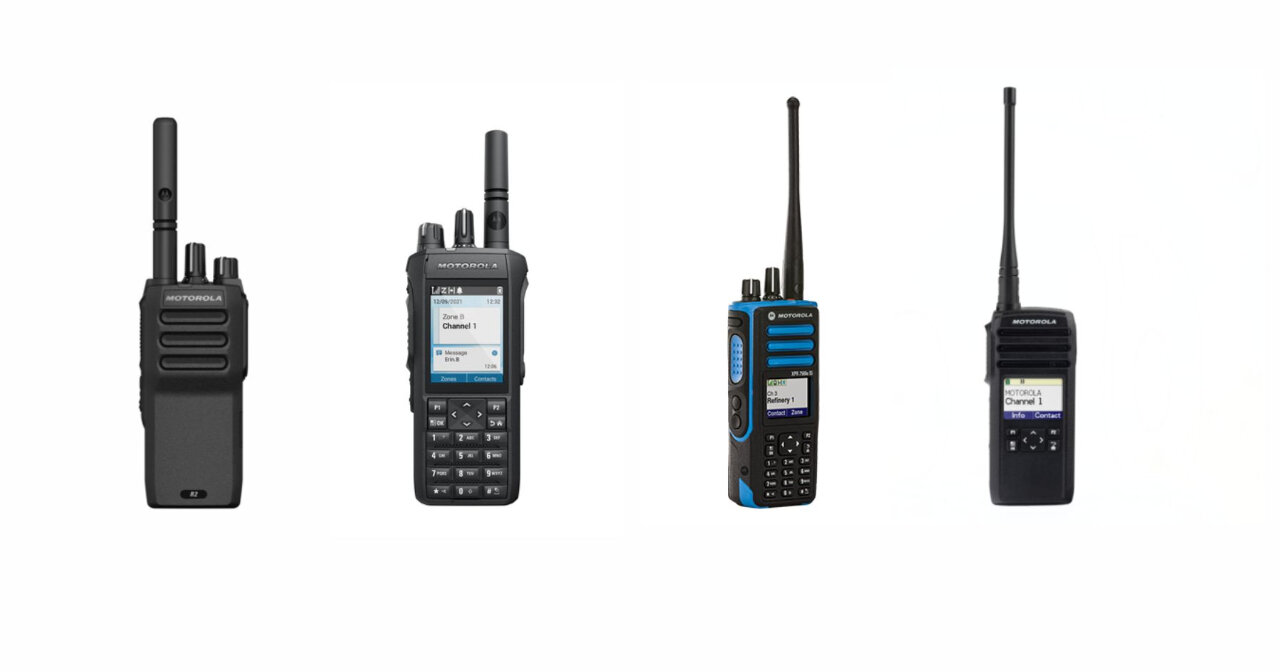
The MOTOTRBO R7 and XPR 7580e IS both support DMR Tier III natively. If a facility is already running either model in a conventional setup, moving to trunked operation means deploying a system controller and reprogramming — not replacing the radios.
What to Ask Before Spec’ing a Trunked System
Three questions cut through most early design decisions.
- Are your current problems coverage or capacity? If users drop calls in specific locations, you need RF work before trunking helps. If users wait for clear channels, trunking addresses the root cause directly.
- What's your expected user count at full deployment, and what does your five-year growth plan look like? ISED asks this in the licence application because it determines how many frequencies the system needs from the start. Underbuilding and expanding later adds licensing time that a well-scoped initial deployment avoids.
- Does your facility require intrinsically safe equipment? The XPR 7580e IS carries CSA Division 1 certification for hazardous locations including Class I Groups A through D. That certification applies to the complete trunked configuration, not just the radio hardware. Our guide to intrinsically safe radio specifications covers the classification requirements in detail.
For facilities that haven't done a formal RF assessment, that's the starting point. It maps signal strength throughout the facility, identifies control channel coverage requirements, and determines whether a DAS is needed before the trunked system goes live. It's also what turns a trunked system design from a drawing into a deployment that works.
If your operation is approaching the channel capacity limits of a conventional system, contact us to schedule an RF assessment. We'll map your site, identify what a trunked deployment requires, and give you a clear picture of what the system needs to cover your teams reliably.